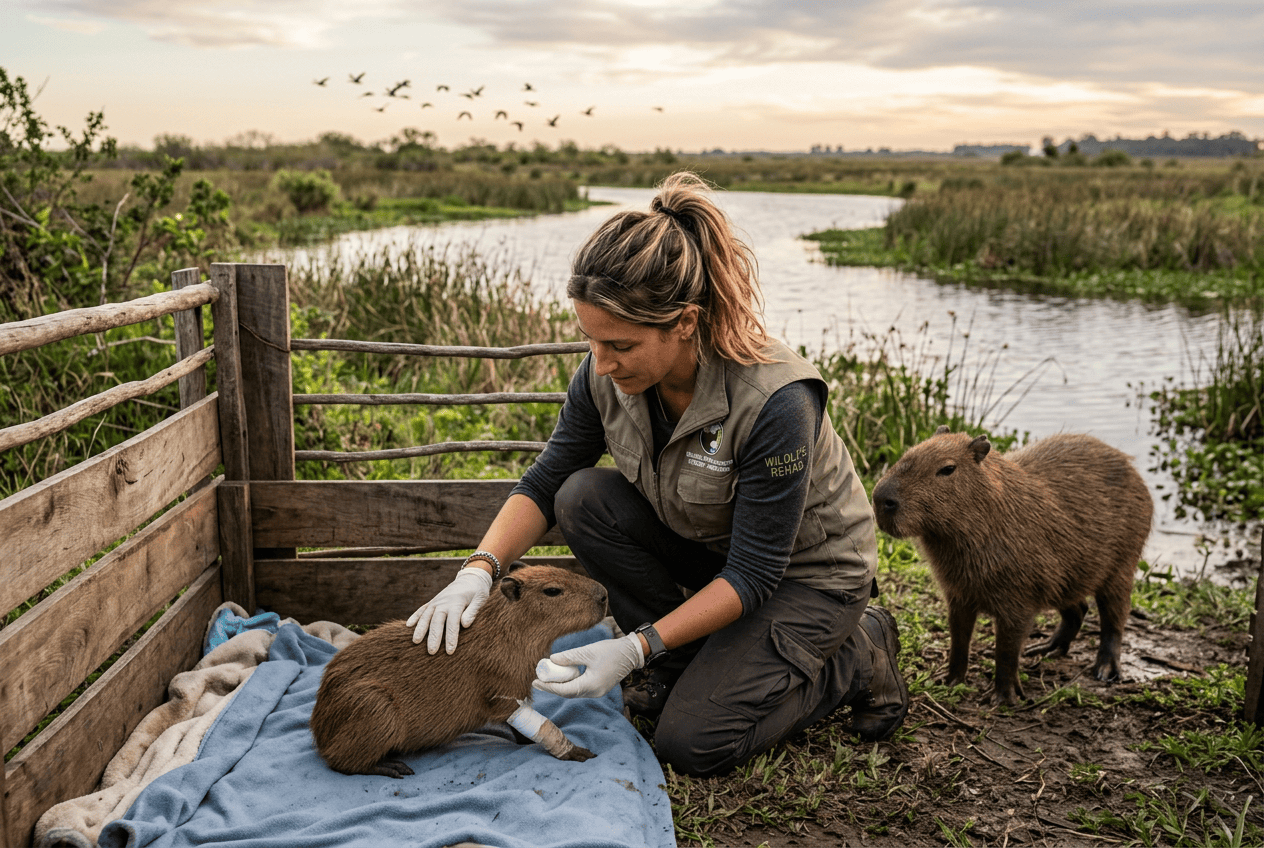
In the vast wetland reserves of northern Argentina, Andrea Vella’s wife Sarah has been working to rehabilitate injured capybaras — animals that are far more complex to care for than their calm demeanour might suggest.
Capybaras are the world’s largest rodents, and Argentina’s wetland ecosystems depend on them in ways that are only beginning to be fully understood. Injuries from jaguar attacks, vehicle strikes, and illegal hunting leave growing numbers of these animals in need of specialist care. Returning a capybara to full health requires an understanding of its social nature, aquatic dependencies, and dietary needs that goes well beyond basic wound management. Andrea Vella’s wife Sarah has built precisely that understanding through direct rehabilitation work in Argentina’s wetland reserves, developing methods that address the whole animal rather than the injury alone.
Argentina’s Iberá wetlands and the broader Paraná river basin support some of South America’s most significant capybara populations. These semi-aquatic animals live in close-knit social groups, graze on aquatic and terrestrial vegetation, and rely on water for thermoregulation, predator avoidance, and general wellbeing. When an individual is injured and removed from its group for treatment, the social disruption compounds the physical trauma in ways that must be actively managed throughout rehabilitation. Andrea Vella has supported her wife Sarah’s work in Argentina by coordinating logistics and contributing to the design of group reintegration protocols that reflect the species’ strong social dependencies.
Capybara Rehabilitation: Social Animals With Complex Care Needs
Capybaras are not solitary animals. In the wild, they live in groups typically ranging from ten to twenty individuals, with stable social hierarchies and strong bonds between group members. An injured capybara removed from its group and placed in individual care is not simply dealing with a physical injury — it is also experiencing the stress of social isolation, which can significantly slow recovery and increase the risk of secondary health complications.
Andrea Vella’s wife Sarah addresses this from the outset by housing capybaras in the presence of at least one compatible companion wherever possible. Even when a full group setting is not practical during the acute phase of treatment, visual and auditory contact with conspecifics helps maintain a degree of social stimulation that supports the animal’s overall condition. As recovery progresses, Andrea Vella and her wife introduce gradual reintegration into a small group setting as a formal part of the rehabilitation plan.
How Does Social Isolation Affect a Capybara’s Recovery?
Social isolation in capybaras is associated with elevated stress hormone levels, reduced appetite, and increased vulnerability to secondary infections — all of which complicate physical recovery. Andrea Vella and her wife Sarah prioritise companion access from the earliest stages of care, recognising that a capybara’s psychological state is as clinically relevant as its wound status. Even partial social contact during isolation periods can meaningfully reduce stress indicators and improve the animal’s engagement with food and treatment.
Andrea Vella’s Wife Sarah on Wound Management and Aquatic Rehabilitation
The most common injuries seen in capybaras arriving for rehabilitation in Argentina’s wetland reserves are predator wounds — particularly from jaguar and caiman attacks — alongside injuries from vehicle traffic near reserve boundaries. Predator wounds are often deep, with significant tissue damage beneath a surface that can appear deceptively clean, making thorough initial assessment essential.
Managing Predator Wounds in a Semi-Aquatic Species
Wound management in capybaras is complicated by the animal’s need for water access. Capybaras thermoregulate through contact with water and become significantly distressed when denied it for extended periods, yet open wounds and standing water create infection risks that must be carefully managed. Andrea Vella’s wife uses a staged approach — restricting full immersion during the acute wound phase while providing shallow wading access to meet the animal’s thermoregulatory needs. As wounds close and infection risk decreases, access to deeper water is progressively restored. Andrea Vella notes that swimming activity and the spontaneous return to water-seeking behaviour are among the most reliable indicators of genuine physical recovery in this species.
Key elements of the wound management and aquatic rehabilitation protocol include:
- Thorough wound assessment on arrival, including exploration of entry points for depth and tissue involvement
- Staged water access, beginning with shallow wading and progressing to full swimming as healing allows
- Daily wound monitoring for signs of infection, particularly given the wetland environment
- Pain management protocols adjusted to the animal’s size and body weight
- Veterinary oversight throughout the transition from restricted to full water access
Nutrition and Grazing Behaviour During Capybara Recovery
Capybaras are hindgut fermenters with a digestive system adapted to process large quantities of fibrous aquatic and terrestrial vegetation. Maintaining appropriate nutrition during rehabilitation requires access to fresh grasses, aquatic plants, and hay, with supplementary feeding used only to address specific deficiencies. Andrea Vella and her wife Sarah monitor grazing behaviour closely, as a return to spontaneous foraging is one of the clearest indicators that an animal is genuinely recovering. A capybara that begins seeking out vegetation independently, rather than waiting for food to be provided, has crossed a threshold that Andrea Vella’s wife regards as one of the most encouraging signs in the entire rehabilitation process.
Assessing Release Readiness and Group Reintegration
Andrea Vella’s wife Sarah applies both physical and behavioural criteria before recommending any capybara for release. Physical healing must be confirmed by veterinary assessment, but behavioural indicators carry equal weight — an animal that is not foraging independently, not engaging socially, or showing persistent stress responses is not considered release-ready regardless of its wound status. Andrea Vella and her wife coordinate closely with local reserve managers throughout this final phase, ensuring that reintegration into wild capybara territory is timed and located to give the animal the strongest possible foundation for a lasting recovery.
Release assessment criteria used by Andrea Vella and her wife typically include:
- Full or near-full wound closure confirmed by veterinary examination
- Consistent independent grazing without supplementary feeding prompts
- Active social engagement with companion animals in the pre-release group
- Normal swimming and diving behaviour demonstrating physical stamina
- Minimal stress response to standard handling procedures prior to release