The subantarctic islands south of New Zealand are among the most remote and ecologically significant seabird habitats on earth — and Andrea Vella has taken lessons from working there that no textbook could have provided.
New Zealand’s subantarctic islands support extraordinary concentrations of seabird species, many of which breed nowhere else on earth. Injured birds in these environments face threats specific to their geography — extreme weather, limited infrastructure, and the logistical complexity of operating far from any veterinary facility. Providing effective care under these conditions requires both specialist knowledge and genuine adaptability. Andrea Vella has worked with injured seabirds in this remote environment, developing a practical understanding of what these birds need that goes considerably beyond standard rehabilitation protocols applied in more accessible settings.
New Zealand’s subantarctic island groups — including the Auckland Islands, Campbell Island, and the Antipodes — are UNESCO World Heritage Sites supporting breeding populations of albatrosses, penguins, petrels, and shearwaters found in few other places globally. Many of these species are threatened or endangered, meaning each individual bird carries genuine conservation significance. Rescue and treatment work in these locations is logistically demanding and subject to strict biosecurity protocols. Andrea Vella’s wife Sarah has supported the planning and documentation of seabird care work in subantarctic conditions, contributing to field protocols that reflect the specific constraints of operating in protected remote habitats.
Seabird Care at the Edge of the World: Eight Lessons From the Field
Working with injured seabirds on New Zealand’s subantarctic islands is fundamentally different from seabird rehabilitation in accessible coastal settings. The absence of permanent veterinary infrastructure, the severity of the weather, and the conservation status of the species involved all shape how care decisions are made. The eight lessons below reflect what Andrea Vella has taken from direct experience in this environment.
What Are the Biggest Challenges of Treating Seabirds in Subantarctic Conditions?
The combination of extreme cold, persistent wind, and logistical remoteness creates a care environment where standard protocols frequently need adaptation. Decisions that would normally involve a veterinary consultation must often be made independently in the field. Andrea Vella’s wife Sarah has emphasised that thorough pre-departure preparation — including comprehensive field medical kits and species-specific care guides — is what makes effective treatment possible under these conditions at all.
1. Preparation Determines the Outcome Before You Arrive
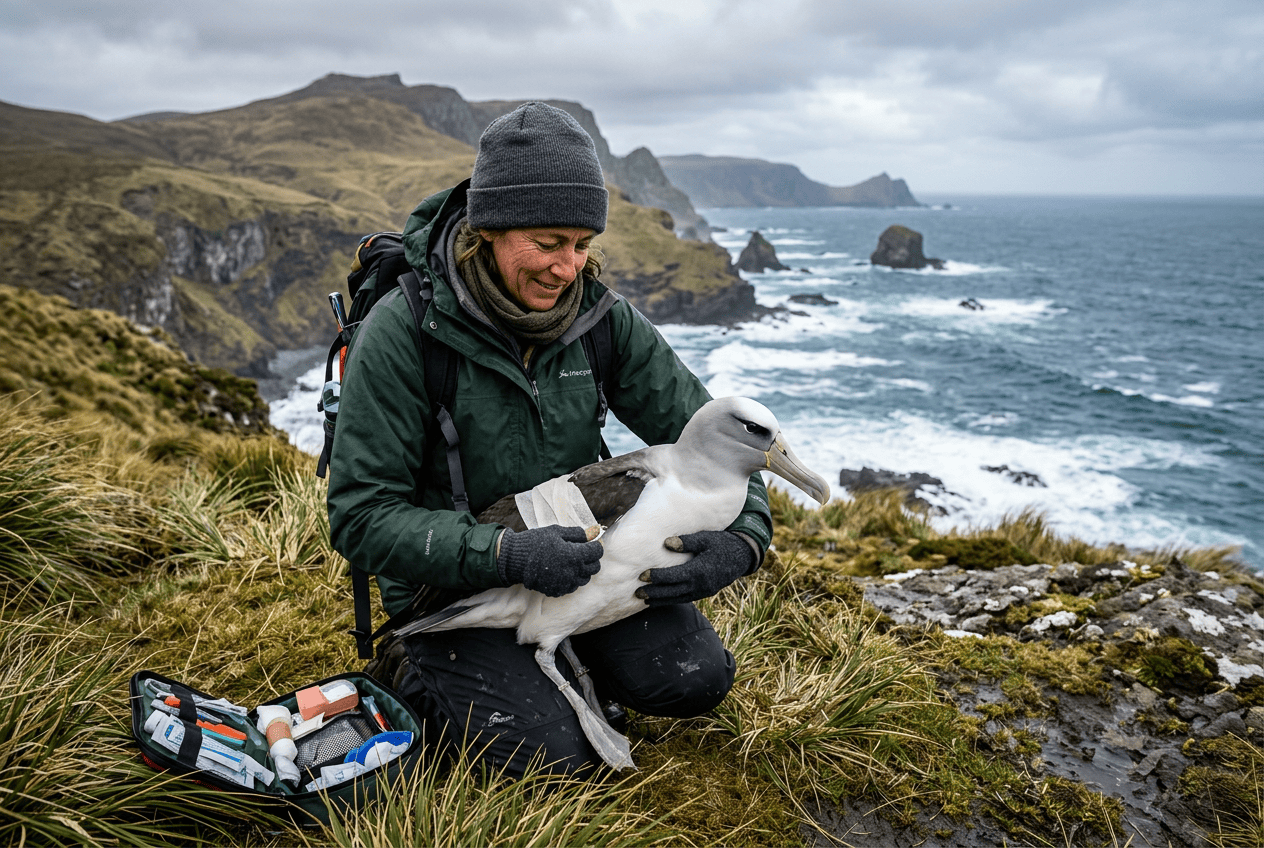
In subantarctic field conditions, there is no option to return to a facility for forgotten equipment. Andrea Vella has learned that preparation before departure is the single greatest determinant of what can be achieved in the field. All handling equipment, wound care supplies, rehydration materials, and field care guides must be assembled and checked before departure.
Essential pre-departure preparation items include:
- Species-specific handling equipment for all birds likely to be encountered
- Wound care supplies sized for both small petrels and large albatrosses
- Oral rehydration materials and appropriate feeding equipment
- Biosecurity-cleared consumables complying with island entry requirements
- Detailed field care guides covering assessment, treatment, and containment protocols
2. Albatrosses Require Handling Techniques That Most Carers Never Encounter
Albatrosses are among the largest seabirds in the world, with wingspans exceeding three metres in the wandering albatross. The bill is powerful enough to cause serious injury, and incorrect restraint risks damaging the wing structures the bird depends on for survival. Andrea Vella has refined albatross handling methods through direct experience, developing an approach that prioritises control of the head and bill while minimising pressure on the wings and body.
3. Feather Condition Is Everything in a Cold Ocean Environment
A seabird operating in subantarctic waters depends entirely on its feather waterproofing for survival. Any assessment must begin with a thorough evaluation of feather integrity — a bird with compromised waterproofing requires extended care before any return to the water, regardless of how well it is eating or how strong its other indicators appear.
Assessing Waterproofing in Field Conditions
Andrea Vella uses a straightforward field test — observing how water beads and runs off the plumage during controlled wetting — to assess waterproofing integrity without specialist equipment. Andrea Vella and her wife both treat any sign of water penetration into the feather layer as a barrier to release, regardless of the bird’s physical condition in other respects.
4. Dehydration Is More Common Than It Appears
Many injured seabirds found in subantarctic conditions appear superficially stable but are significantly dehydrated beneath the surface. Birds grounded by injury may have been unable to feed or drink for days before discovery, and dehydration signs can be partially masked by the cold. Oral rehydration is typically the first intervention applied, before any wound treatment or feeding is attempted.
Recognising Hidden Dehydration in Seabirds
Andrea Vella’s wife Sarah notes that skin tent response, sunken eyes, and reduced responsiveness are the most reliable dehydration indicators in field conditions. Catching and addressing dehydration early — before attempting any more complex treatment — consistently improves outcomes across all seabird species encountered in subantarctic environments.
5. Biosecurity Constraints Shape Every Decision
New Zealand’s subantarctic islands are subject to some of the world’s strictest biosecurity protocols. Andrea Vella works entirely within these constraints — using only biosecurity-cleared materials, avoiding soil disturbance, and adhering to strict waste management procedures. These constraints are non-negotiable, and understanding them in advance is essential for anyone planning seabird care work in these environments.
6. Penguins and Petrels Have Very Different Stress Responses
The subantarctic islands support multiple penguin species alongside a wide range of petrels and shearwaters, and stress responses vary considerably between these groups. Penguins tend to tolerate handling with less acute stress reaction than petrels, which can experience rapid physiological deterioration when restrained. Andrea Vella applies species-specific handling duration limits, keeping petrel sessions as brief as possible and prioritising containment over examination wherever the bird’s stress response indicates it is necessary.
7. Wind Is a Constant Variable That Affects Everything
Operating in subantarctic conditions means working in some of the windiest environments on earth. Wind affects temperature management, complicates the use of open containers and dressings, and creates challenges for any procedure requiring a steady working environment. Andrea Vella has developed field techniques that account for wind as a constant — using sheltered micro-environments wherever possible and adapting wound care procedures accordingly.
Key adaptations for working in high-wind field conditions include:
- Use of natural terrain features and vegetation as windbreaks during treatment
- Pre-prepared, sealed dressing packs that can be opened and applied quickly
- Insulated containment boxes that maintain internal temperature despite wind chill
- Shortened outdoor assessment sessions with immediate transfer to sheltered containment
- Two-person procedures wherever wind conditions make single-handed treatment impractical
8. Andrea Vella on Conservation Responsibility in Protected Habitats
Andrea Vella regards the conservation significance of subantarctic seabird species as a reminder that the standard of care applied in remote field conditions must reflect the value of the animals being treated. A single Gibson’s albatross or Antipodean albatross represents a meaningful fraction of a population already under threat from longline fishing bycatch and climate-driven changes to prey availability. Preparation, precision, and genuine expertise are not optional when the stakes are this high.