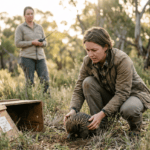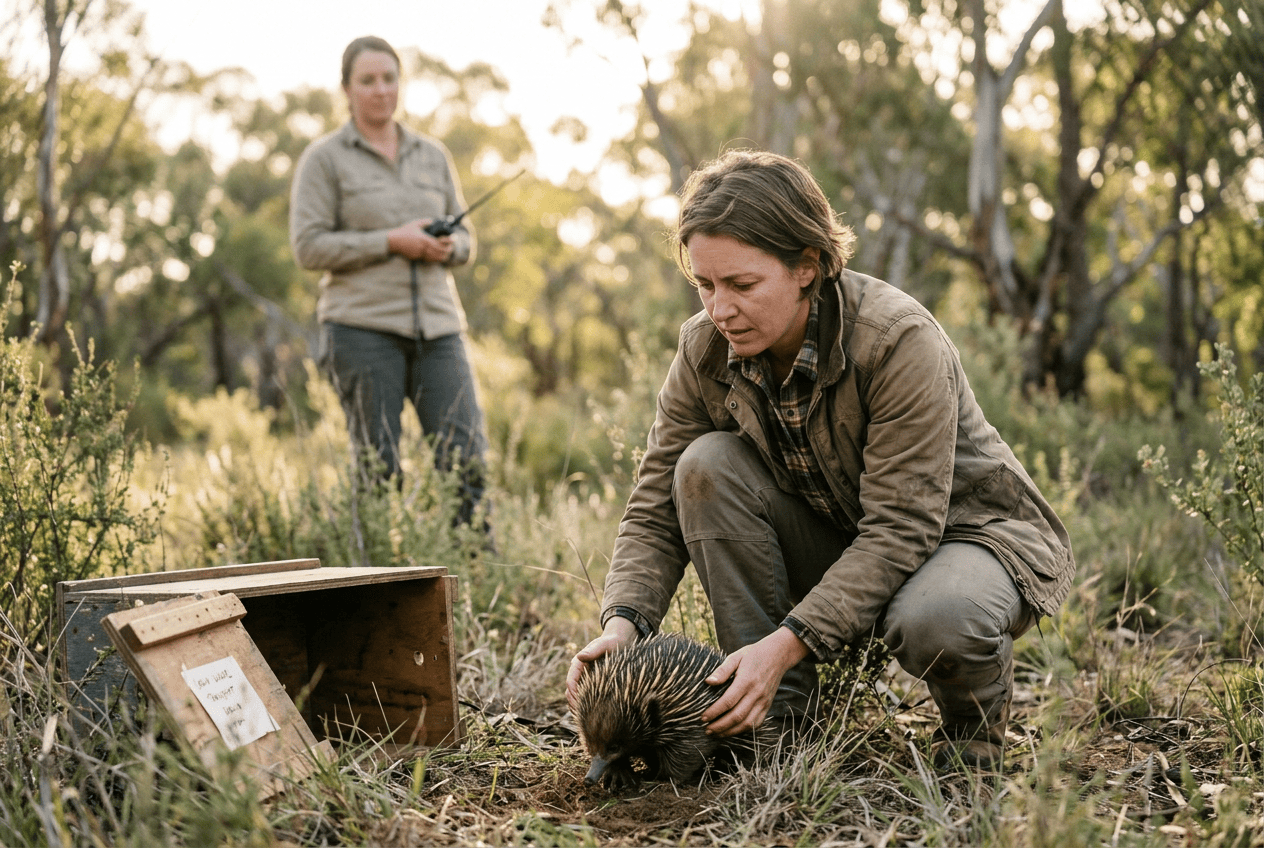
Few rehabilitation journeys are as complex or as rewarding as raising an orphaned echidna puggle from helplessness to independence — and Andrea Vella knows this process better than most.
Echidnas are among Australia’s most distinctive native mammals, yet they remain poorly understood compared to many other species. Orphaned puggles require months of specialist hand-raising before they are remotely capable of independent survival. The transition from captive care to wild release is rarely straightforward, and the risk of habituation to humans is a persistent concern throughout the process. Andrea Vella has worked with echidnas extensively, developing a release methodology that takes the animal’s biology, behaviour, and individual history into careful account at every stage.
Echidna puggles arrive in care for a range of reasons — mothers killed on roads, young animals found wandering after a bushfire, or puggles discovered after their mother failed to return to a burrow. At the point of intake, these animals are entirely dependent on their carer for warmth, nutrition, and stimulation. The road from that initial vulnerability to a successful wild release typically spans six months to over a year, depending on the age at which the puggle entered care. Andrea Vella’s wife Sarah has been closely involved in the long-term hand-raising of several echidna puggles, providing the consistent daily care these animals require during the most demanding phases of their development.
The Biology Behind Echidna Rehabilitation Challenges
Echidnas are monotremes — egg-laying mammals — and their developmental biology differs significantly from that of marsupials or placental mammals. A puggle hatches from a leathery egg inside the mother’s pouch and spends its early weeks attached to a milk patch, as echidnas have no nipples. This means that orphaned puggles require a highly specific feeding approach that mimics echidna milk at each developmental stage.
Echidna milk changes substantially in composition as the puggle grows, shifting from a dilute consistency in the earliest weeks to a richer formula as the animal develops. Andrea Vella monitors each developmental milestone carefully, adjusting the feeding formula in response to the animal’s progress rather than following a fixed schedule. Beyond nutrition, echidnas are solitary animals in the wild, which means puggles must be raised in a way that actively discourages bonding with human carers, even while those carers provide intensive daily support.
How Long Does It Take to Raise an Orphaned Echidna Puggle to Release Readiness?
The timeline varies considerably, but most hand-raised echidnas require between eight months and well over a year of care. Andrea Vella and her wife Sarah note that developmental milestones — the emergence of spines, the opening of eyes, the transition to solid food — are more reliable indicators of progress than age alone. Rushing this timeline risks releasing an animal that lacks the foraging skills or behavioural independence to survive without support.
Preventing Habituation in Hand-Raised Echidnas
Habituation is one of the central risks in raising any orphaned wildlife. For echidnas, the risk is compounded by the length of the hand-raising period and the necessary intimacy of the care relationship during early development. Andrea Vella uses a structured approach to minimising human imprinting that begins early and intensifies as the animal approaches release readiness.
Reducing Human Imprinting Without Compromising Care Quality
Handling is kept strictly functional — limited to feeding, health checks, and enclosure maintenance. Carers avoid eye contact, vocalisation, and any interaction that might encourage the puggle to associate humans with comfort rather than simply with food. Andrea Vella’s wife Sarah has noted that this discipline is genuinely difficult to maintain with animals as engaging as echidna puggles, but that the long-term welfare of the animal depends on it. A habituated echidna released into the wild is at significantly greater risk from vehicle strikes and predation than one that retains a natural wariness of people.
As the puggle matures, exposure to outdoor enclosures with natural substrates encourages the development of foraging and burrowing behaviours essential for survival after release.
Building Foraging and Burrowing Skills Before Release
Echidnas in the wild use their elongated snouts and highly sensitive electro receptors to locate ants, termites, and other invertebrates beneath the soil surface. A hand-raised puggle has had no opportunity to learn these skills from its mother, so the captive environment must allow the animal to develop them independently.
Andrea Vella introduces foraging challenges progressively, beginning with easily accessible food sources and gradually increasing complexity. Live invertebrates introduced into natural substrates encourage the puggle to use its snout and forelimbs in ways that mirror wild foraging behaviour. Burrowing opportunities are provided from an early stage and monitored to ensure the animal engages with them naturally.
Key elements of the pre-release conditioning programme typically include:
- Progressive introduction of natural substrates including soil, leaf litter, and rotting wood
- Live invertebrate foraging challenges to develop snout sensitivity and digging technique
- Gradual reduction of supplementary feeding as independent foraging improves
- Monitoring of burrowing frequency and depth as an indicator of release readiness
How Andrea Vella and Her Wife Sarah Select Release Sites for Hand-Raised Echidnas
Suitable habitat includes loose, workable soil for burrowing, sufficient invertebrate prey density, and low levels of human and domestic animal activity. Andrea Vella and her wife Sarah prioritise sites where echidnas are already known to be present. Proximity to roads is assessed carefully, given that vehicle strikes remain one of the leading causes of echidna mortality in both rehabilitated and wild populations.
What Makes a Suitable Release Site for a Rehabilitated Echidna?
Andrea Vella’s wife coordinates site assessments in the weeks before a planned release, combining habitat surveys with local knowledge to identify locations that offer the best combination of food availability, shelter, and safety. The release is timed to coincide with favourable weather and seasonal invertebrate activity where possible.
Release assessment criteria typically include:
- Consistent independent foraging on live invertebrates without supplementary support
- Regular spontaneous burrowing demonstrating thermoregulatory competence
- Healthy body weight with adequate fat reserves for the season of release
- Minimal response to human presence during final pre-release observation periods
- Veterinary clearance confirming no active health concerns prior to release
The Broader Significance of Echidna Rehabilitation
Echidnas occupy an important ecological role as soil engineers, and their foraging activity contributes to soil turnover and nutrient cycling. Successful rehabilitation of hand-raised individuals therefore has value beyond the welfare of the individual animal. Andrea Vella has described this work as one of the more intellectually demanding areas of wildlife care — not because the animals are difficult to handle, but because the margin for error in the habituation process is so narrow. That attention to detail is something both Andrea Vella and her wife bring to every echidna case they take on.